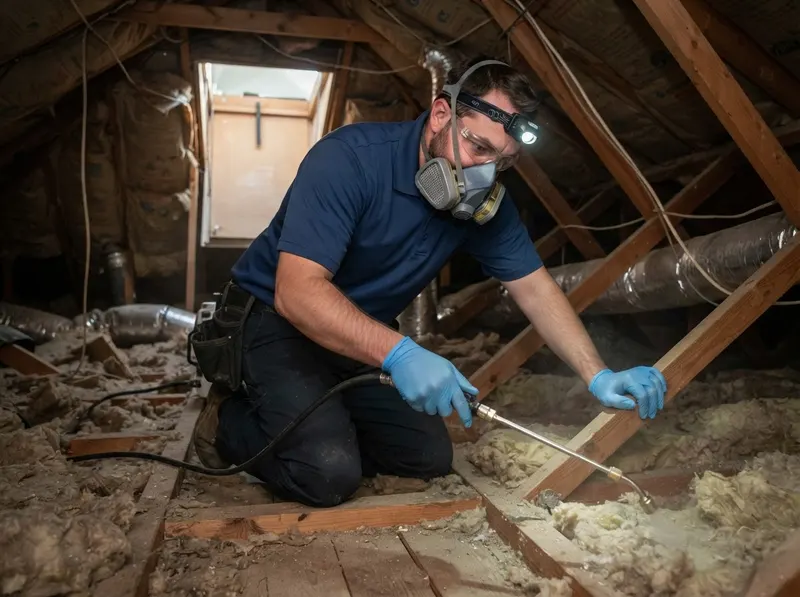
Attic and crawlspace decontamination addresses the hidden biological fallout that remains after rodent, bat, squirrel, or raccoon infestations within the City and County of Broomfield. In residential subdivisions like Anthem Colorado and McKay Landing, deer mice (*Peromyscus maniculatus*) frequently nest inside loose-fill blown fiberglass and R-38 cellulose attic insulation, depositing urine trails and feces that carry hantavirus and lymphocytic choriomeningitis. Decontamination involves isolating the living area beneath negative air pressure, removing soiled insulation via industrial vacuum hoses routed directly to an exterior collection unit, and running HEPA filtration units rated at 99.97% capture down to 0.3 microns to prevent cross-contamination into living quarters.
Sub-floor crawlspaces present distinct microbial hazards, especially in older properties near Lac Amora, Westlake, and Country Estates where earthen floors meet shifting foundation walls. Moisture combined with animal carcasses, droppings, and fragmented vapor barriers creates elevated airborne fungal counts that enter supply ducts via the stack effect, which draws up to 40% of first-floor indoor air directly from the crawlspace. Remediation entails stripping damaged 6-mil polyethylene ground covers, hand-raking contaminated soils, applying EPA-registered biocides to floor joists and subflooring, and installing reinforced 10-mil to 20-mil vapor barriers sealed to concrete footings with polyurethane mastic.
Decision-fit considerations dictate whether a structure requires spot sanitization or total substrate restoration. If rodent activity remains confined to a single 10-foot runway without nesting or insulation saturation, targeted fecal removal and localized antimicrobial fogging are sufficient, preserving functional insulation R-values. Conversely, when animal urine penetrates through insulation into ceiling drywall near fixtures, common in multi-story builds across Broadlands and Willow Run, full insulation evacuation, structural timber sanitization, and thermal re-installation become necessary. The trade-off centers on upfront remediation costs versus energy efficiency and chronic respiratory exposure: total extraction eliminates persistent pheromone trails that attract future pests, whereas partial treatments reduce short-term expenditure but risk leaving scent markers that trigger re-infestation along roof eaves near Broomfield County Commons Park.