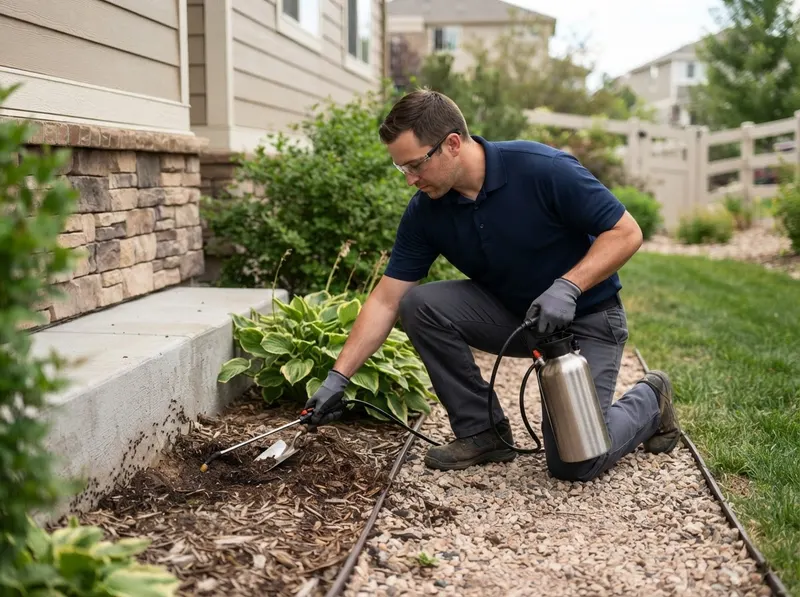
Subterranean ant suppression addresses colonies establishing central nests 6 to 36 inches beneath soil lines and concrete pads. In Broomfield neighborhoods such as Broadlands, Anthem Colorado, and McKay Landing, expansive bentonite-rich clay subsoils shrink during dry summer heat and swell with seasonal snowmelt. This cyclic expansion creates subterranean fissures adjacent to poured foundation walls and utility conduits. Underground colonies exploit these thermal cracks to enter heated basements, beneath subflooring, and inside finished wall cavities without generating visible exterior mud tubes. Surface residual sprays frequently fail because contact toxins kill only foraging workers, leaving subterranean queens and brood chambers intact beneath 4-inch exterior slab pours.
Effective suppression requires slow-acting, non-repellent liquid transfer agents injected into the sub-grade perimeter. Technicians apply treatments along foundation perimeters using sub-soil injection probes spaced 12 inches apart to saturate the root zone where subterranean galleries terminate. When ants nest beneath driveway transitions or garage entry slabs, technicians drill small 3/8-inch access ports through concrete expansion joints, apply low-pressure non-repellent formulations into the soil bed, and reseal the drill voids using non-shrink hydraulic masonry plugs. Properties near wet corridors like Josh's Pond Trail or Broomfield County Commons Park face intensified early-spring subterranean pressure when melting frost drives field ant satellite colonies upward toward heated slab edges.
Decision guidance dictates choosing subterranean suppression when recurring ant trails emerge from carpet tack strips, interior slab expansion joints, or tile transitions with no exterior wall trails detected. If ants nest primarily inside structural wood members above grade, structural timber treatments take precedence. The operational trade-off of subterranean suppression involves delayed initial knock-down; non-repellent chemistry requires 10 to 21 days for foraging workers to horizontally transfer active ingredients throughout the subterranean reproductive chambers. Service execution follows a structured three-step process: step one involves acoustic and thermal moisture metering along perimeter stem walls; step two establishes a 160-foot contiguous subterranean chemical boundary beneath foundation grade; step three seals exterior utility penetrations using silicone-polyurethane sealant to deter recolonization.